
 Gavin Duff
Performance marketing regularly stops working on its own because it’s a harvester…
Harvesters bring in a crop. They don’t grow one. What it cuts down is demand that already exists, the people who know you and are halfway to the checkout.
Paid search, paid social, retargeting, shopping ads… all of it is built to catch buyers at the moment they’re ready to move. That’s a genuinely useful thing to be good at.
The catch is that nobody has ever fixed an empty field by buying a bigger harvester, and the ready buyers always run out eventually. When they do, more budget just means you’re paying more to cut less.
What is performance marketing actually for?
Performance marketing is there to capture demand that already exists, not to create it. Its job is the harvest: scooping up buyers who already know you and are close to a decision. Paid search, retargeting and shopping ads are demand-capture tools. They cash in on intent that something else, usually your awareness work, built earlier.
For the first while it feels like you’ve found a cheat code. You switch it on, the revenue lands, every euro is accountable, and the dashboard lights up like a fruit machine that only ever pays out. Leadership’s delighted. Nobody wants to hear a word against it.
Here’s the part that flatters you into complacency. There’s almost always some natural demand already standing in the market, people who’d have gone looking for something like you whether or not you ever ran an ad.
Switch the harvester on, and you sweep them all up at once, so you get a real uplift. But it’s a one-off. You didn’t grow that crop, you just got to it first. Once you’ve cut the buyers who were already there waving money at you, the field doesn’t quietly reseed itself out of gratitude.

Why does performance marketing get more expensive over time?
Performance marketing gets more expensive because everyone’s cutting the same small field. At any given moment, only a sliver of your market is actually ready to buy. Pile more competitors into that sliver, and the price of reaching it goes up: cost per click climbs, return on ad spend slides, and the pool of in-market demand doesn’t refill just because you’d like it to.
The Ehrenberg-Bass Institute’s 95:5 research, run by Professor John Dawes for the LinkedIn B2B Institute, found that only around 5% of business buyers are in-market in any given quarter. The other 95% aren’t shopping. They’re locked into a contract elsewhere, or perfectly happy where they are.
Either way, they’ve no reason to think about you today. That 5% is the whole field your bottom-funnel ads are allowed to touch.
So when growth stalls, most businesses reach for the one move guaranteed to make it worse. They panic and shovel more money in. Bigger budget, more campaigns, a shinier attribution model, a new agency with a nicer deck. It’s buying a combine harvester to mow a five-a-side pitch. There’s nothing left in the ground.
The extra spend doesn’t conjure buyers who were never going to buy this quarter. It just bids up the price of the handful who were, and hands the difference to Google.
What actually creates demand?
Demand gets created by awareness marketing, which is a bigger job than the phrase “brand awareness” makes it sound. It works on three levels: making people aware they have a problem worth solving, aware that a product like yours solves it, and aware of your brand in particular.
The first two can pull someone toward the market. The last one makes sure they pick you when they get there.
Reducing all of that to “brand awareness” is where a lot of businesses trip up. If nobody thinks the problem is worth fixing, no amount of logo recall will help, because they aren’t looking yet.
Need awareness is the article or campaign that shows a buyer their problem is costing more than they realise, which is how latent demand gets surfaced and someone drifts from the 95% toward the 5%.
Product and service awareness is the explainer or the demo that gets you shortlisted once they start looking. Brand awareness is what makes you the safe choice when they finally commit.
Cut the whole lot and file it under “brand”, and you’ve quietly defunded the part that was actually growing the market.
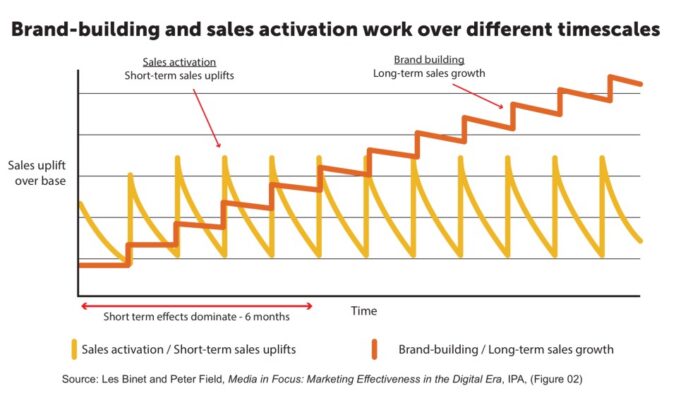
This is the backbone of Binet and Field’s long-running IPA research, built on close to a thousand effectiveness case studies. When they say “brand building”, they mean this whole broad, long-term awareness job, not a nicer logo.
Their finding, repeated across a decade of follow-up reports, is that the most profitable split is about 60% of budget on that work and 40% on activation. The true sweet spot sits a little higher, nearer 62:38 in its favour.
That work is slow and unglamorous, and it pays. It lifts the baseline, so every performance campaign after it starts from higher ground, because more people already know the problem is worth solving and know you’re one of the answers before the ad even loads. Skip it, and you’re back to cutting the same shrinking patch, week after week, and the yield only ever drops.
Why does cutting the awareness budget feel smart and then blow up?
Cutting the awareness budget feels smart because it doesn’t pay you back this quarter. It pays back roughly 12 to 18 months later. So when money gets tight, that spend is first out the door. It’s the line nobody can defend on a spreadsheet by Friday afternoon. And for a good while, the numbers hold. That delay is the whole trap.
Watch how it goes off. You pause the awareness campaigns and park the sponsorship. The explainer content and the category pieces that were teaching people they had a problem quietly disappear too. Nothing bad happens, not at first. The performance ads keep humming along. Leadership does a lap of honour: see, we never needed all that fluffy awareness stuff, look at what we saved. For twelve, maybe eighteen months, everyone’s a genius.
Then the field comes up bare. The pipeline thins, your cost per acquisition starts climbing, and there’s suddenly no demand left to catch. The market didn’t die, and your product didn’t get worse overnight. You just stopped feeding the only thing your harvester was ever eating.
Peter Field’s analysis of the IPA databank found that as short-term campaigns grew from around 10% of cases in 2002 to 25% by 2018, overall effectiveness dropped with them. His verdict is blunt: under-investing in brand is the more damaging of the two mistakes you can make, and it’s also by far the more common one. That clever saving on the spreadsheet was a payday loan against next year, and the interest is coming whether you budgeted for it or not.
| Performance marketing (the harvest) | Awareness marketing (the planting) | |
|---|---|---|
| Job | Catch buyers who are already in-market | Create future buyers who aren’t in-market yet |
| Works on | Existing intent | Need, product and brand awareness |
| Timescale | This week to this month | Roughly 6 to 18 months |
| Measurement | Immediate and easy to attribute | Slower and harder to attribute |
| Reaches | The 5% ready to buy now | The 95% who’ll be ready later |
| Failure mode | Costs climb as the ready pool shrinks and rivals crowd in | Effect fades if you stop, but the damage stays invisible for a year |
| Typical channels | Paid search, retargeting and shopping ads | Broad-reach social and video, PR, category education, product explainers and demos, and sponsorship |
How much should you spend on awareness versus performance?
Start near a 60:40 split, 60% awareness and 40% performance, then adjust for how long your buying cycle is and how well known you already are. The trick is refusing to pick a side. The businesses that make growth look easy are planting and harvesting at the same time. Awareness fills the field, performance brings in the crop.
None of this makes performance marketing the bad guy. It’s doing exactly the job it was built for, and 40% of the budget is a serious slice, not a rounding error. The mistake is asking a harvester to grow the crop.
If you’re genuinely up against it, a few months of runway and payroll to make, then fine, tilt hard to activation until you can breathe again. Call that survival rather than strategy, but it’s a fair call. Everyone else should flex the mix around one stubborn rule: keep planting.
In practice, that means running your Google Ads and PPC to bring in the buyers who are ready now, while paid social campaigns and content build the need, product and brand awareness in the 95% who aren’t, with a digital strategy deciding the split on purpose instead of leaving it to whatever the last quarterly panic decided for you.


 Mary Brennan
 Dave Jackson