 Gavin Duff
It was only a matter of time…
ChatGPT was too clean, too useful, too popular to be left alone. Now the ads are on the way.
For the last couple of years, ChatGPT has been the place people went to escape the usual internet garbage: the screaming banners, the retargeting that follows you like a needy ex, the algorithmic sludge that makes you feel like your brain’s been marinated in crisps.
You asked a question, you got an answer. It felt clean. Nearly polite. You probably even said ‘please’ or ‘thank you’ to it at some point.
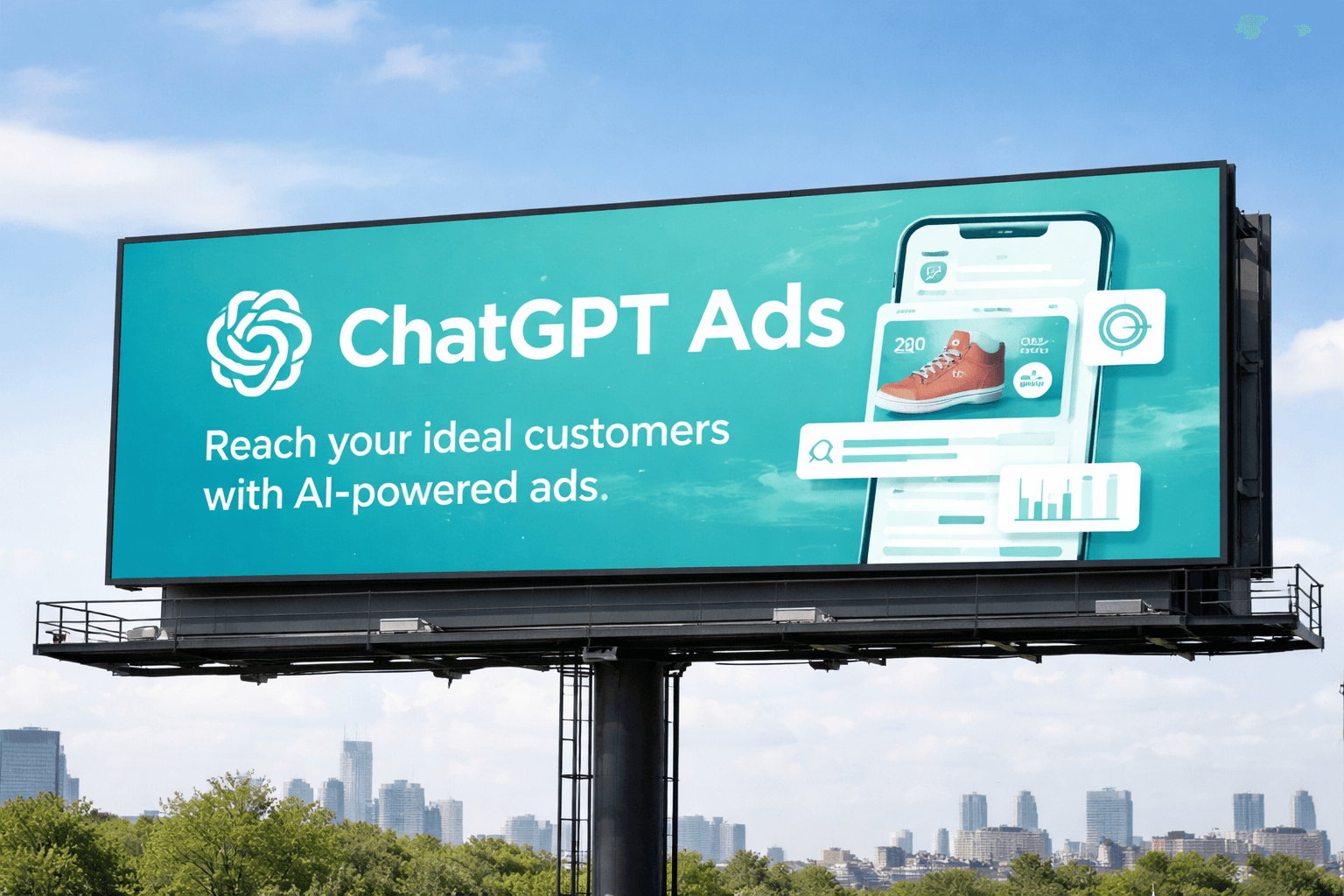
And now OpenAI has confirmed it will start testing ads in ChatGPT in the United States, initially on the free tier, with paid tiers staying ad-free. Ads will be clearly labelled, shown separately from the answer, and (according to OpenAI) won’t influence the answer itself.
Here is an example of how an ad for Friday Agency might look when appearing underneath a relevant response:

So yes: the glass has hit the floor.
And if you’re an advertiser in Ireland, you can feel the floorboards vibrate already – even if we’re not invited to the US test party.
Where This Sits in the Irish Media Mix: Somewhere Between Google Ads and Contextual Display
ChatGPT ads, as described so far, look like a hybrid of search intent and contextual placement:
Why it’s like Google Ads (but not the same)
- People are in active problem-solving mode: planning trips, choosing software, comparing services, writing emails, picking gifts and troubleshooting life.
- The “moment” is often mid-intent – not always ready to buy, but ready to decide.
- It’s close to search in spirit: user expresses intent → system surfaces options.
Why it’s like contextual display (but sharper)
- Targeting is based on the topic of what’s being discussed, not necessarily a declared keyword.
- You’re effectively buying your way into a context, not stalking a person around the web with a profile.
The key difference between the two
ChatGPT isn’t a results page, and it isn’t a website. It’s a conversation, and a conversation is slippery.
On Google, the query is a nailed-down thing. Even when it’s messy, you can point to it and say: this is what the user typed.
In a chat, intent can arrive sideways. Someone starts with “write a best man speech”, ends up asking “also where can I rent a suit in Galway”, then they’re suddenly talking about whether navy is “too corporate”. It’s human. It meanders. It contradicts itself.
That creates opportunity, and a new kind of uncertainty.
The “Blindness” Problem: Will We Know What People Typed? Will We Even Know Where Our Ads Showed?
You’re not wrong to be suspicious here. But the truth is more specific than the fear.
OpenAI’s stated principles include “conversation privacy” and “we never sell your data to advertisers.”
WIRED reports OpenAI says advertisers won’t be able to see user info like age, location, or interests, and will get aggregate performance metrics (impressions/clicks).
So the direction of travel looks like:
- No prompt-level transcript access for advertisers.
- Likely no “search term report” equivalent where you see the exact phrases people used.
- Reporting that’s more like “your ad appeared in X number of relevant conversations about Y.”
What we don’t yet know (and should not pretend we know)
OpenAI hasn’t yet published advertiser documentation that confirms:
- Whether you’ll get topic categories or “reason codes” at scale
- Whether there’ll be placement controls (like excluding certain conversation themes) beyond the sensitive-topic rules
- Whether there’ll be brand safety layers as you’d expect from YouTube or the Google Display Network.
- Whether “why am I seeing this ad?” explanations will be user-only or partly visible to advertisers
So: yes, it’s partly blind. But it’s a deliberate privacy-first kind of blind, not an “OpenAI forgot to build reporting” kind of blind.
For Irish advertisers used to squeezing performance out of query reports, placement reports, audience segments, and GA4 event spaghetti, that’s going to feel like someone’s taken away your dashboard and handed you a compass.
Not useless. Just different.
Why Ireland Should Care Early (Even if We’re Not in the First Wave)
Because Ireland is where ad ecosystems come to live, tax-resident, and throw manners on the table.
We’ve got:
- brands that over-index on performance media
- agencies that move fast when there’s an edge
- a market that’s small enough to test in, and sophisticated enough to scale out of
And we’ve also got a practical reality: the minute this rolls out beyond the US, the early winners will be the ones who already know how to be present inside AI answers, not just beside them.
The organic work brands have been doing to show up in chat-based experiences becomes the scaffolding for paid placements.
In other words: the ads won’t arrive in a vacuum. They’ll land on top of everything you’ve already done (or ignored) about your brand’s clarity online.
What This Could Do to the Irish Advertising Landscape (The Good, The Bad, The Weird)
1) It could create a new “high-intent middle”
Google Search is the bottom of the funnel for a lot of Irish advertisers. Meta is the reach machine. TikTok is the chaos engine. Display is… there, somewhere, running in the background like a fridge you don’t remember buying.
ChatGPT ads could slot into a new space:
- not quite “I’m ready to buy right now”
- not quite “I’m just browsing”
- more like “I’m deciding, and I want help”
If OpenAI gets the experience right, it could be the most commercially valuable “consideration” environment we’ve seen in a decade because the user is actively asking for assistance, not passively consuming content.
2) It could punish vague brands
ChatGPT is allergic to fluff. If your proposition reads like it was written by a committee that’s never met a real customer, the model will summarise you into oblivion.
And when ads arrive, the ad isn’t just fighting other ads – it’s fighting the answer, which will often include lists, comparisons, pros/cons, and alternatives.
If you sell “innovative solutions for modern needs”, you’ll get treated accordingly.
3) It could be brilliant for smaller Irish businesses if the targeting stays contextual
OpenAI frames this as a way to help smaller businesses compete.
If the system prioritises relevance to the conversation topic (and doesn’t drift into hyper-personal surveillance), then a small Irish brand with a clear niche could show up at exactly the moment someone needs them.
That’s the dream: less stalking, more usefulness.
4) It could be a measurement headache
Aggregate reporting is fine until you’re trying to justify budget.
If you can’t see:
- what people said (in exact terms)
- which “topics” were mapped
- what else the user saw
- whether the click came from curiosity or purchase intent
…then attribution gets fuzzy fast.
That doesn’t kill the channel. It just means you’ll need new ways to evaluate it:
- lift tests
- controlled geo tests (when geo is available)
- incremental conversions
- brand search deltas
- onsite behaviour quality
The Irish market is actually good at this when it has to be. It just hates having to be.
5) It could change the role of creative
Search creative is compact: headline, description, extensions, job mostly done.
ChatGPT creative could be more like:
- a useful mini-offer
- a crisp promise
- a landing page that answers follow-up questions instantly
Because the moment someone clicks, they’re already in “ask me anything” mode. Your landing experience can’t be a brochure. It has to behave like a helpful person who isn’t trying too hard.
How Targeting Might Work (And How to Think About It Before the Controls Are Public)
Based on OpenAI’s statements and reporting, early targeting is likely to be driven by conversation topic relevance.
So, rather than obsessing over keywords, Irish advertisers should start thinking in:
“Situations” instead of “search terms”
- “Someone planning a weekend in Dingle”
- “Someone comparing accounting software”
- “Someone trying to pick a gym”
- “Someone looking for a mortgage broker but embarrassed about asking”
- “Someone organising a hen party and panicking quietly”
ChatGPT is full of these little human situations. That’s the inventory.
“Questions people don’t type into Google”
This is the real shift.
Google is where people go when they’re happy to be seen wanting something.
ChatGPT is where people go when they want to ask the slightly mortifying version of the question. When you think someone might be scarleh for ya.
That’s powerful. It’s also delicate. OpenAI knows it, and hence the heavy emphasis on trust and sensitive-topic exclusions.
What Irish Advertisers Should Do Now (Before You Can Even Buy a Single Impression)
This is the part that matters, because the buying interface will arrive when it arrives. But the groundwork is yours to do.
1) Sort out what you want to be known for, in one sentence
Not a mission statement. Not a values page. One sentence that a model could repeat without laughing.
If you can’t describe the category you’re in and why you’re different without using words like “leading” or “solutions”, you’ll struggle in a conversational environment. You’ll rightly struggle anywhere, to be honest.
2) Build “answer-shaped” landing pages
If the ad appears under an answer, you need the click to feel like a continuation, not a jarring gear change.
Landing pages that will do well in this environment tend to:
- answer the next 5 obvious questions
- show pricing/starting points (or explain why you can’t)
- prove credibility fast (reviews, case studies, certifications)
- let the user take a small next step (not “Book a demo” as the only option)
3) Prepare your product/service data like it’s going to be parsed, not admired
Clean, structured, consistent info wins in AI contexts.
Think:
- clear product naming
- unambiguous descriptions
- real differentiators
- FAQs that don’t waffle
4) Decide your privacy line before the platform forces you to
OpenAI is leaning privacy-first in its public messaging. In Ireland (and the EU generally), the tolerance for creepy targeting is already thinning.
So decide now:
- Are you comfortable with personalisation?
- Do you want to be “helpful and present” or “aggressively optimised”?
- What categories do you refuse to advertise around, even if the platform allows it?
That’s not ethics theatre. It’s brand protection.
5) Get your “GEO” house in order (Yes, it’s a thing)
Call it “Generative Engine Optimisation” or don’t. Agencies are already talking about GEO as the foundation for showing up in AI conversations, both paid and organic.
The practical version is simple:
- make your site readable
- make your claims provable
- make your content consistent across the web
- stop contradicting yourself in different corners of your digital footprint
What This Might Mean for Google (And Why You Shouldn’t Throw Your Search Budget Out the Window)
A lot of hot takes will scream “Google is finished”. It isn’t. Not in the slightest.
Google still owns:
- navigational intent (“login”, “address”, “opening hours”)
- transactional intent (“buy”, “price”, “near me”)
- the habit loop of billions of people
What changes is the top and middle of the funnel.
If ChatGPT becomes the default place where people start exploring, then Google becomes the place they go to confirm, compare prices, and execute. Which is still valuable, but different.
For Irish advertisers, the most likely scenario is not replacement, but rebalancing:
- ChatGPT ads for consideration moments
- Google Search for capture and conversion
- Meta/TikTok for scale and demand creation
- Display for reach (and occasionally, regret)
ChatGPT ads, if they work, could become that rare thing: a paid channel that doesn’t feel like it hates the user.
ChatGPT Ads vs other ad platforms
| Platform | Primary role | User mindset | Where it wins | What you’re buying |
|---|---|---|---|---|
| ChatGPT Ads | Influence decisions inside conversations | Thinking and researching | Mid-funnel consideration | Attention during thinking |
| Google Ads | Capture existing demand | High-intent and task-driven | Bottom-funnel conversions | Intent |
| Meta Ads | Create and reinforce demand | Passive scrolling | Awareness and recall | Attention during distraction |
| TikTok Ads | Manufacture attention through entertainment | Passive but highly engaged | Top-funnel acceleration | Attention during entertainment |
| LinkedIn Ads | Reach people by professional identity | Work-focused and evaluative | B2B lead generation | Attention during work |
The Risks Irish Advertisers Should Take Seriously (Without Getting Dramatic)
Brand safety in a conversational world
Even with sensitive topic exclusions, conversation is unpredictable. A harmless topic can drift into something touchy in three messages.
OpenAI will need strong guardrails. Advertisers will need strong exclusions. We don’t yet know how granular those controls will be.
Over-trust in the platform’s “answer independence”
OpenAI says ads won’t influence answers. That’s the promise, and it’s important.
But advertisers should still assume:
- user perception is fragile
- if users feel answers are being nudged, backlash will be swift
- regulation will follow attention, and attention will follow controversy
Click quality swings
Early inventory is often expensive and weird:
- high curiosity clicks
- novelty behaviour
- people clicking just to see what happens
If you test, test with eyes open. Don’t declare the channel “dead” because week one looked odd. Week one always looks odd!
A Practical Irish Launch Forecast (What’s Likely, Based on What We Know)
OpenAI is starting with a U test and says it plans to expand globally. That usually means:
- limited formats
- limited advertiser access
- cautious rollout
- policy tightening as edge cases appear
- then expansion
For Ireland, the key unknown is timing. But the strategic reality is simpler:
- once it lands in Europe, it will move quickly
- the first advertisers in will get disproportionately strong learnings
- late adopters will inherit a more competitive, more expensive auction
So, Should Irish Advertisers Be Excited?
You can be curious without losing the run of yourself.
If OpenAI holds to the principles it has published – privacy, separation, labelling, answer independence – then ChatGPT ads could be one of the more “sane” additions to the media landscape in years.
And if it drifts the other way, if it becomes a subtle manipulation engine wearing a helpful face, then it’ll be a short honeymoon and a long fallout.
Either way, it’s coming.
And Ireland, being Ireland, will either:
- complain loudly and adopt it anyway, or
- adopt it loudly and complain anyway
Same thing, different ordering.
Get Ahead of It
When the glass hits the floor, the people who move first aren’t always the loudest. They’re just the ones who were already standing.
If you want to be in the first Irish wave that actually knows what it’s doing, get in touch with Friday to get early access to ChatGPT Ads when it arrives. Work with a ChatGPT Ads agency before the channel launches.


 Dave Jackson
 Richard Lawton