
 Gavin Duff
Google says clicks are fine. Our data says something different… click-through rates are down by 26% in Ireland.
Everyone in SEO has an opinion on AI Overviews. Half the industry is convinced they’re quietly strangling organic traffic, the other half thinks it’s overblown panic from people who haven’t updated their content strategy since 2019.
Google, for its part, says everything’s grand, that overall click volume to websites has stayed “relatively stable,” that AI features are simply creating new opportunities for people to discover websites. Which is one way to describe a feature that answers the question before anyone reaches your site…
We were tired of arguing about it with no numbers in front of us, so we pulled them. Sixteen months of Google Search Console data, across a huge number of Irish websites covering many sectors. Combined, those accounts surfaced in 175 million searches over the period. Not a vendor’s aggregated dataset. Not a global average that flattens a dozen different industries into one tidy figure. Our own data, looked at without anyone trying to sell us another ‘AI platform’ at the end of it.
Here’s what we found.
Key findings at a glance
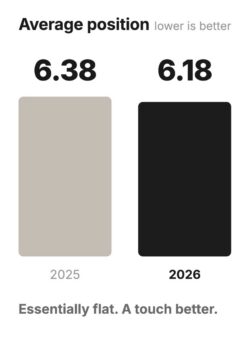
- Average position across our Irish client accounts improved slightly year-on-year (6.38 → 6.18)
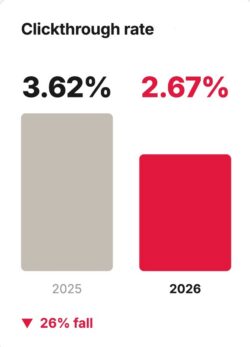
- Click-through rate dropped 26% over the same period (3.62% → 2.67%)
- Informational and question-format queries are the most affected query types at positions 4-10
- Transactional and commercial-investigation queries are holding up significantly better
- The effect shows up as a slow CTR decline rather than a ranking drop, making it easy to miss in standard reporting
What we actually did (and why we can’t just show you the AI Overview data directly)
Google doesn’t tell you which queries triggered an AI Overview and which didn’t. There’s no toggle for it. Google only added a dedicated AI performance report to Search Console on June 3rd this year, and even that only shows impressions broken down by page, country, device, and date. No clicks, no CTR, no query-level view, and it’s still rolling out to a subset of sites. So anyone telling you they can show you clean “AI Overview click data” right now is rounding up.
So instead of pretending to have a flag we don’t, we classified every query by intent (informational, transactional, commercial-investigation (the “best,” “compare,” “vs,” “reviews” type searches), navigational/brand, and general) and by format (question-style, short phrase, medium phrase, long-tail), then compared click-through rate and average position across those groups.
Question-format and informational queries are, by a wide margin, the ones most likely to trigger an AI Overview. That’s not a guess; Ahrefs found that AI Overviews appear more often for informational queries, longer searches, and queries with higher search volumes, while showing up less for branded, local, and shorter searches. No surprises there.
One other thing worth saying upfront: our data only goes back to February 2025, which is after AI Overviews had already rolled out broadly in Ireland. We can’t show you a clean “before AI Overviews” baseline, because we don’t have one. What we can show you is sixteen months of trend within the AI Overview era, with a year-on-year comparison that controls for seasonality by putting the same months against each other.
Rankings improved. Clicks fell anyway.
The simplest version of what we found: rankings got slightly better across the board, and click-through rate dropped by more than a quarter.
We compared the same four months, March to June, across 2025 and 2026. Average position across the full client set was 6.38 in spring 2025 and 6.18 in spring 2026. Marginally better. Average CTR went from 3.62% to 2.67% over the same stretch. That’s a 26% fall.
 .
. 
If rankings had gotten worse, you’d shrug and call it a ranking problem. You’d rewrite some page titles, check your content quality, go through the usual motions. A CTR drop with stable or improving rankings is a different kind of problem, because it’s not a problem your SEO checklist has a box for. Something between you and the click changed. The rankings didn’t.
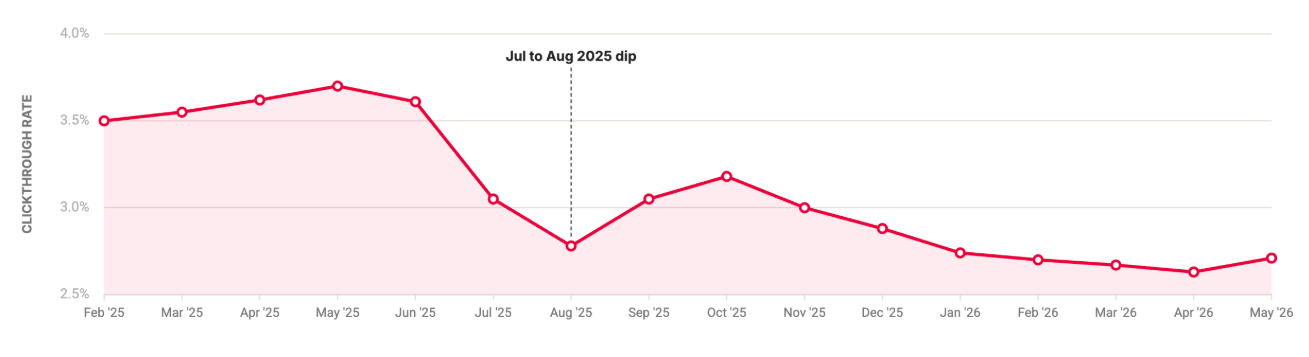
Month-to-month the picture is messier, which is worth showing rather than smoothing over. CTR sat around 3.3-3.8% through spring and early summer 2025, dropped sharply in July and August alongside a temporary spike in average position (likely a broader algorithm shift rather than anything account-specific), recovered slightly through autumn, and has sat in a lower band of roughly 2.5-2.8% for most of 2026. It’s not a clean downward line. It’s a step change that held.
Where the damage actually sits (it’s not everywhere)
The more useful finding isn’t the overall drop, it’s where it concentrates. Not every query type took the same hit. Not every position band tells the same story.
At positions 1-3, the gap between query types is smaller than you might expect. Informational queries held a reasonable CTR at the top of the page, not far off transactional terms. Getting into the top three still gets you a click, regardless of query type, more often than not.
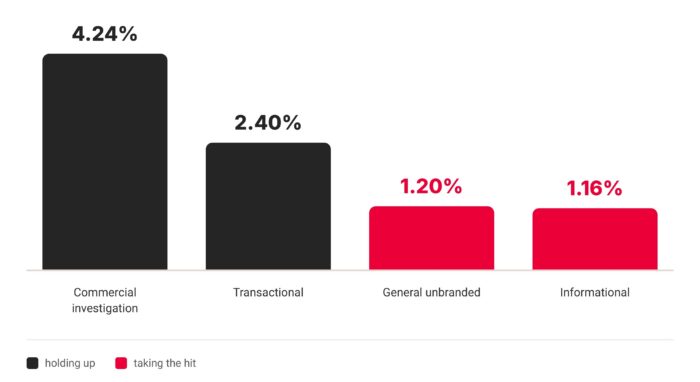
The damage is at positions 4-10, where most non-branded organic content actually lives day to day. At those positions, informational and general non-branded queries were pulling click-through rates of around 1.1-1.2%. Transactional and commercial-investigation queries at the same positions were converting at roughly double that rate. Commercial-investigation terms specifically came in at 4.24% CTR at positions 4-10. Informational queries at the same positions: 1.16%. That’s not a small gap.
Question-format queries averaged a CTR of 2.7% overall, but that figure is pulled down by the fact that question queries tend to rank worse on average (position 6.7 versus lower figures for short-phrase and medium-phrase terms). Part of that gap is “questions rank lower.” Part of it is an AI Overview answering the question before anyone scrolls to your listing.
None of this means informational content is finished. It means the assumption that ranking well for an informational query gets you a click in 2026 the same way it did in 2023 is no longer safe, particularly once you’re outside the top three.
How this lines up with the bigger studies
Our numbers are smaller in scale than Ahrefs’ often-quoted research, where they found a 34.5% drop in CTR when an AI Overview was present versus similar informational queries without one, a figure that had worsened to a 58% reduction by December 2025. We’re not measuring the same thing; they’re isolating individual keywords with and without an Overview, while we’re comparing categories of intent across a fixed client cohort over time. But the direction is the same across two completely different methodologies, and that consistency is, if anything, more convincing than either study on its own.
Pew Research’s work approaches it from the user side rather than the publisher side. Their tracking of real browsing behaviour found that people were far less likely to click through to a website when an AI summary appeared in the results than when it didn’t, and that clicking on a link inside the AI Overview itself was rare. Google disputed the study’s methodology (worth mentioning for “balance”, I suppose!) but the user behaviour Pew described matches almost exactly what we’re seeing in click data sixteen months on.
What this actually means for your site right now
If your site relies on informational content sitting between positions four and ten, you are likely losing more clicks than your dashboards are telling you. The drop shows up as a slow CTR decline rather than a ranking drop, and it’s easy to miss if position is the metric you’re watching most closely.
Transactional and commercial-intent pages are holding up better, which tracks with what the bigger studies have found about which query types AI Overviews are less likely to interrupt. If you rank well for “how to” or “what is” queries and you’ve noticed your traffic from those pages softening despite stable rankings, this is probably what you’re looking at.
The practical question isn’t really “how do I write different content?” It’s “what is this content actually for now?” Ranking well for an informational query and getting the click is a smaller prize than it used to be. Being the source the AI Overview actually cites, or owning the transactional queries that still convert clicks reliably, matters more than it did two years ago.
That shift is part of why our AI visibility audit exists as a separate thing from standard SEO strategy: the two questions that matter now are where you’re still earning the click, and where you need to start earning the citation instead. They’re not the same question, and they don’t always have the same answer.
We’ll rerun this analysis in six months when we have a cleaner two-year window. If the gap we’re seeing keeps widening at its current rate, a content calendar tweak isn’t going to fix it.
Want to know where your own site sits in this? Talk to Friday, and we’ll pull the numbers on your account.


 Evan O'Reilly
 Mary Brennan