
 Evan O'Reilly
Whether they’ve come to us for SEO or PPC, the first question most new clients ask is, “How do I start showing up on ChatGPT?”
It’s a fair question. It’s a relatively new platform, and with the explosion in people using AI, it feels crucial to show up there. But this month, one of the biggest changes to how shoppers judge your brand didn’t happen in ChatGPT. It happened in Google Ads.
Google is now putting your reviews inside your ads
Google has published new guidance confirming that review summaries can appear directly inside Google Search ads. These are short AI-written recaps of your online reviews, pulled from across the web.
To some, that might immediately raise alarm bells, but Google will only use positive sentiment. You can’t change the wording or choose which reviews are used. Google decides when to show them, based on whether it expects them to lift performance. They’re currently running in English in the US, UK, Australia and India. It’s not live in Ireland just yet, but given how Google usually rolls these things out, it’s worth preparing now rather than waiting.
In other words, your reviews are now ad copy you don’t write. If customers rave about your delivery speed, Google might put that in front of searchers. If nobody has said anything good about your returns process, there’s nothing for the AI to work with.
That’s a big shift. For years, paid search has been about controlling the message: testing headlines, refining descriptions, finding the copy that converts. Now part of the ad is written by your customers and edited by Google. The brands that benefit most will be the ones whose customers are already saying the right things.
Why this matters more than it might seem
To understand why this is such a big deal, it helps to look at what shoppers actually do after an AI tool recommends something.
Feedvisor’s latest survey of US shoppers found that 16% now name ChatGPT as a starting point for product searches. But only 5% say they would buy straight away after an AI recommendation. Most go and check first, a third head straight for reviews, just over a fifth compare prices, and nearly one in five go to Amazon or another retailer to check the product there.
So AI might build the shortlist, but it’s something else that decides who gets the purchase.
In the vast majority of cases, that something else is still Google. Similarweb’s 2026 research found that around 95% of ChatGPT users also used Google. It’s not a case of one being swapped out for the other. Both have their place in the funnel.
The traffic numbers back this up. In Search engine land, SEO consultant Marie Haynes analysed 100 websites and found that ChatGPT sent just 0.62% as many sessions as Google organic, and Google organic delivered 27 times as many conversions as every AI platform combined.
So while everyone is asking how to show up in ChatGPT, the moment that decides the sale is still happening on Google. And Google has just made your reviews part of that moment, in the ads as well as the organic results.
Why reviews decide it
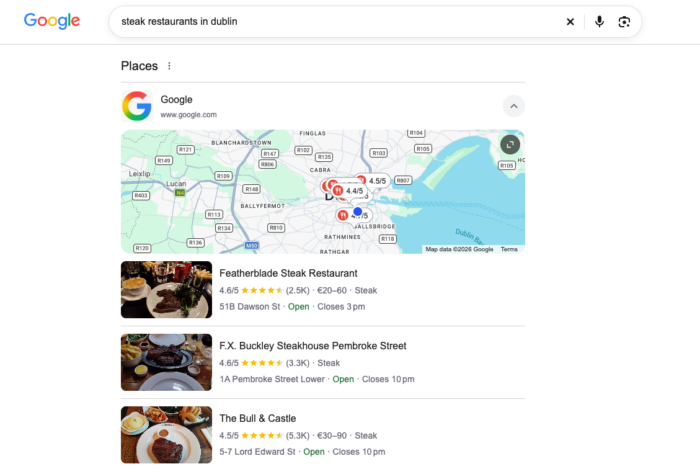
Reviews are one of the most powerful tools for bridging the gap between researching and purchasing. We’ve all done it. You find a product you really want, available from multiple retailers. Before making the decision to buy, you check the reviews, star ratings and delivery service, to name a few. Ultimately, if the price is the same across the board, reputation and trust are the deciding factors.
Think about how that plays out after an AI recommendation. A shopper asks ChatGPT for the best option, gets three suggestions, then goes to Google to check them out. If one brand has hundreds of recent, detailed reviews and the other two have a handful from 2022, the decision is almost made before they’ve even clicked.
I’ve done this exact thing just last week while shopping. I was searching for a specific product. The exact product I wanted appeared on multiple websites. One had the better deal in terms of price, but was from a website I hadn’t heard of with infrequent and old reviews, while the other was a reliable brand I’ve bought from previously that has a constant flow of reviews but was a little more expensive. I chose the one slightly more expensive because I knew it was from somewhere I could trust with regular reviews.
We’ve always pushed our SEO clients to gather as many positive reviews as possible for local SEO, but this now applies to paid media as well. Review generation is no longer just an organic task. It feeds directly into how your ads look and, potentially, how well they perform.
What brands can do now
Here are some things brands can do to show up well, with Google’s review summaries in mind.
- Read your reviews the way Google’s AI will. Look across Google, Trustpilot, Amazon and anywhere else your brand gets talked about. What would a positive summary say? What’s missing? If your reviews praise the product but never mention service, that’s a gap worth closing.
- Ask for reviews at the right moment. The best time to ask is shortly after a good experience, usually once the order has arrived or the service has been delivered. Make it easy with a direct link, and send a gentle reminder if needed.
- Prompt for detail, not just stars. A five-star rating with no text gives the AI very little to summarise. Asking customers what they liked about delivery, quality or customer service tends to produce richer reviews that give Google more to work with.
- Respond to reviews, good and bad. It shows shoppers you’re listening, and a well-handled complaint can do as much for trust as a glowing review.
- Rebalance your budget. If you’re spending on AI visibility and doing nothing to build reviews, you’re investing in the shortlist and ignoring the part that closes the sale.
Do it properly
One word of caution. The temptation to boost review numbers quickly can lead brands towards incentivised or fake reviews. In Europe there are laws around fake and incentivised reviews, and Google’s own policies don’t allow them either.
Beyond the legal risk, it simply doesn’t work for long. Shoppers are good at spotting reviews that don’t ring true, and a sudden spike of generic five-star reviews can do more harm than good. Steady, genuine reviews from real customers will always be worth more.
The bigger picture
AI tools are becoming the first stop for a lot of shoppers. They aren’t the last. People still want proof from other customers before they part with their money, and Google has just found a way to put that proof straight into its ads.
Getting recommended is great. Being the obvious choice when someone checks is what pays.
Is review generation part of your current strategy across SEO? If not, contact us and we’ll show you where the gaps are.

 Gavin Duff