 Gavin Duff
Everyone has a theory about what people ask ChatGPT…
Most of those theories come from people who use it for work all day and assume everyone else does too. The data says otherwise, and it’s a little humbling.
I went through OpenAI’s published usage data from July 2024 to September 2026. Here’s what stood out and what I’d do about it.
Where does this data come from?
OpenAI publishes a dataset called Signals. It’s a sample of one million consumer ChatGPT messages per month, all from accounts where the user declared they were 18 or over. A model sorts each message into categories like writing, technical help or seeking information, and noise is added for privacy.
Yes, this is OpenAI reporting on its own product, a bit like asking the chipper for the chip statistics. But they’ve published the files and the method; the data is licensed under Creative Commons Attribution 4.0, and I’d rather have imperfect data than a confident guess. Enterprise accounts and Codex are excluded, so work use is understated.
The numbers below come from my own analysis of the files, and the interpretation is mine.
Is ChatGPT still mainly a work tool?
No. Work-related messages fell from 51.6% in July 2024 to roughly 30% in July 2026. They had already dropped to 31% by July 2025 and have barely moved since. It turns out the great workplace revolution was about a third workplace and two-thirds everything else.
Schoolwork follows the academic year. It peaked at about 32% of messages in late 2024 and fell below 11% in August 2026, so even the over-18s take the summer off. It started climbing again in September. Personal use, meaning neither work nor school, is now around two-thirds of messages.
Plan type tells you who’s doing what. In September 2026, 68% of messages on the Pro plan were work-related, against 25% on the free tier. Paying for it focuses the mind.
What are people asking about now?
This compares the average of July to September 2024 with the same months in 2026.
| Topic | 2024 | 2026 | Change |
|---|---|---|---|
| Writing | 33.6% | 21.2% | -12.4 pts |
| Practical guidance | 26.7% | 29.4% | +2.7 pts |
| Seeking information | 16.6% | 20.1% | +3.5 pts |
| Technical help | 12.5% | 4.3% | -8.2 pts |
| Self-expression | 4.3% | 9.2% | +4.9 pts |
| Multimedia | 2.6% | 8.3% | +5.7 pts |
Share of consumer ChatGPT messages by topic, average of July to September 2024 vs July to September 2026
Writing lost 12 points. Technical help fell by about two-thirds, though Codex is excluded from the data, so a good chunk of that has probably moved to coding tools rather than disappeared. Developers haven’t stopped asking. They’ve just stopped asking here.
Multimedia more than tripled, so some of the cursed images on your feed are in these figures. Self-expression more than doubled. About a third of non-work messages are now neither a question nor a task, up from 14%. People are just telling a chatbot things. We’ve all had a friend like that, except this one never says “anyway, enough about me.”
Practical guidance and information-seeking held steady. Together they grew from 43% to 49.5% of all messages. Gizmodo’s coverage of OpenAI’s earlier research paper said about 80% of usage fell into practical guidance, seeking information and writing. In the 2026 data, those three make up roughly 71%, so use is spreading out.
What sits inside those two categories?
The labels are broader than they sound.
Practical guidance covers how-to advice, tutoring and teaching, creative ideation, and health, fitness, beauty and self-care. Seeking information covers specific facts, questions about products people can buy, and cooking and recipes.
Those are the questions a customer asks before they ever contact a business. “How do I choose a solicitor for a house purchase?” is practical guidance. “What does a pest control visit cost?” is seeking information. Most of what businesses publish sits closer to those two categories than to anything else on the list.
What about Ireland?
Ireland ranked 29th in the world for ChatGPT messages per head of population in the third quarter of 2026. It peaked at 25th a year earlier. The UK ranked 41st and the US 49th, which I’d put down to us having opinions and wanting them confirmed.
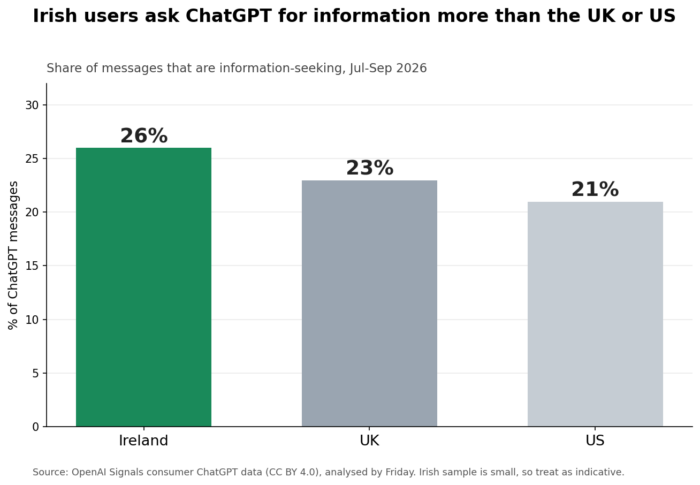
The numbers back that up. Between July and September 2026, 26% of Irish messages were information-seeking, against 23% in the UK and 21% in the US. Irish messages also skew a bit older, with 27% coming from the 35 to 44 age group in September 2026, against 22% in the US.
In work messages, editing written material is the top use everywhere, and Ireland is no exception at 16%. But Irish users are less likely to use it for marketing material (2.8% of work messages, against 5.0% in both the US and UK) and more likely to use it for educational and vocational advice (5.3%, against 3.4% in the US). The Irish sample is smaller, so treat these as indicative. If you’re a copywriter, take the good news where you can find it.
What should you do with this?
This is my reading. The categories show what kind of thing people ask, not the exact words they use. With that said, four things follow.
Write for advice and decision questions. Half of all messages are people asking how to do something or looking something up. Content that answers “how do I”, “which one should I pick” and “is it worth it” has a real audience. Open each section with the answer in a sentence or two, then explain. AI tools pull passages, and a passage that opens with the answer is easy to lift. It’s also what you’d do for a human reader, who has also stopped reading by line three. This is the core of good SEO now, and it works for search engines and chatbots alike.
Put the facts on the page. Seeking information includes questions about things people can buy, and Irish users do more of it. Put prices or price ranges, who the service is for, where you operate and what’s included in plain text. Yes, even if you’re a “contact us for a quote” business. The AI will answer the question anyway, and it will use someone else’s numbers.
Don’t compete with the writing assistant. The machine can write a perfectly competent 800 words on why your service matters. So can every competitor’s machine, and that’s the problem. What it can’t produce is your own data, local knowledge and first-hand experience. A page that says something nobody else says is worth far more than a tidy summary of what everyone says. That’s the thinking behind our content marketing work.
Find out what AI says about you. Take the ten questions a customer would ask before buying from you and put them to ChatGPT. Check whether you appear, whether it’s accurate, and who comes up instead. It takes an hour. You may find it recommends your competitor, or confidently describes you as a firm of undertakers. Better to know. Our AI visibility audit does this properly, across the main AI tools and not just one.
What can’t this data tell you?
It covers consumer accounts only, so business use is understated. Every category is assigned by a model, which means one robot is marking another robot’s homework. Country figures are noisier than global ones, and rank is per head of population, so small countries can bounce around. Most importantly, it shows categories and not individual prompts. It can tell you people want advice. It can’t tell you the exact questions to target, which is what prompt research is for.
So, does your business have an answer?
If you’ve never checked what ChatGPT says when someone asks about your kind of business, now’s the time. We’ll run the questions your customers ask, show you what comes back, and tell you what to fix first.
Data: OpenAI Signals, licensed under CC BY 4.0. Friday analysed the downloaded files.


 Gavin Duff