
 Elliott Mullen
In this digital world we are saturated with websites, apps, and software where functionality and usability are expected, so how do you stand out?
The answer is storytelling. Most websites we use today are optimised for usability and functionality but many lack the empathetic and human connection that is achieved through thoughtful and detailed storytelling.
It can transform simple, overlooked interactions into opportunities to connect with and build relationships with users, not just helping the user solve a problem, but also creating an enjoyable experience that has lasting impact. That’s what elevates an experience from functional to meaningful, and meaningful experiences are what people come back to.
At the end of the day retaining your users is the goal. And you don’t retain users by only being functional, any competitor can do that. You retain them by building relationships, and relationships are built through stories.
The Relationship Between Storytelling and Human Behaviour
A while back I read “Sapiens” by Yuval Noah Harari. If you haven’t read it I’d genuinely recommend giving it a read. While researching for this blog I couldn’t help but think about it. Anyways, in this book Harari writes about human evolution, from us banging rocks together 2 million years ago all the way through to the present day.
A key theme Harari discusses in this book is how humans made the jump from hairy, upright primates to rulers of the planet. Why of all creatures on Earth was it humans who evolved to this level? Harari puts forward the theory that what separates us humans from every other species on our planet is our unique ability to think of and communicate ideas that don’t exist, such as fictional stories. Hariri refers to this as the cognitive revolution.
Money in your bank account is just a number on a screen, a country’s border is an invisible line drawn on a map, and laws are conceptualised imaginary rules used to keep order in society. None of these things have a physical form yet we all abide by them and accept them to be true. They only hold power because we as a society choose to believe in the story behind them. Without this story they are meaningless and cease to exist.
It is rooted in human nature that we are attracted to story telling, so it should be no surprise that the products and experience we enjoy the most are the ones built on the foundation of a coherent story.
What Does Storytelling Mean in UX?
Sometimes when people hear “storytelling” in a UX context they assume it refers to copywriting or how the brand communicates itself. They’re not entirely wrong, words definitely have a part to play.
UX storytelling happens when you weave a user centred narrative into the design process to create a more engaging and empathetic experience. The design does more than solve the users problem. It resonates with them, it understands their problems, and it celebrates success with them.
UX storytelling can look something like this:
The protagonist: Your user, the centre of the story, and who the focus is always on.
The Introduction: Every story establishes the world and sets the scene at the beginning. In UX this is your onboarding experience, the product’s first impression and the first opportunity to communicate value.
Conflict/Climax: Tension, the moment where things get hard for the protagonist. This is the key problem your product is trying to help the user solve.
Resolution: What is the result of the climax? A well crafted design will result in the user achieving what they came to do.
The Ending: A good ending leaves you thinking about it long after you’ve finished it. In UX this is everything that happens after the task is complete. A forgettable ending leads to a forgettable product. A great ending brings them back again and again.
Why is Storytelling Important?
Think of a healthcare app for booking GP appointments. On the surface it’s a tool for scheduling appointments. When you consider the person using the app it becomes more than a simple tool.
Your user could be someone who’s been putting off a visit for some time. They can be feeling anxious, worried, or even embarrassed about their appointment. A designer who sees this and understands it will weave the story into every interaction in the journey. From language used to feedback given, every interaction is tailored to the feelings and situation of the user and their goals.
Implementing this story will help reduce friction, reassure users at times of conflict, provide clarity when needed most, and ultimately create a more enjoyable experience.
Leverage Emotion
Storytelling in UX design adds emotion to your product, and emotion can be incredibly effective at building trust with your users. Helping them celebrate wins or consoling them when something goes wrong really builds that connection
A personal example I have from my day to day is the unicorn from the task management tool Asana. For those of you who don’t use Asana, when you click complete on a task that was assigned to you a unicorn accompanied by bright rainbow colours zooms past your screen (See image below). I feel like I may be a bit too old to be getting excited about a unicorn and some colours but it does add a level of joy to what is typically a mundane action.
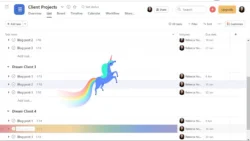
It’s one of those “delight features” that is implemented for the sole purpose of connecting emotionally with the user, and I’m not ashamed to say it works. It’s not trying to sell you anything and it doesn’t try to push you to the next step. It’s just a small moment purely focused on the user and giving them a little pat on the back and saying “good job”.
The emotion doesn’t always have to be positive. It’s equally important for a product to be considerate when things go wrong. If a payment fails or if a page doesn’t load, a cold system error message that tells the user there’s an issue can take them out of the story. However, a thoughtful human approach that helps users resolve the issue can keep them in it.
The Bottom Line
The best products aren’t just the most functional, they’re the ones that feel grounded and human. The ones that understand their user, their emotions, and design every interaction around this. The product solves a problem while building lasting relationships
Storytelling shouldn’t be a nice to have. It can be the difference between a product people use and a product people continue to comeback to. So next time you’re working on a project, before any pencils come out, or any wireframes are drafted, ask yourself: What story am I trying to tell?
If you want to work with a UX Agency that understands the power of great storytelling and great design, get in touch with us today.


 Gavin Duff
 Dave Jackson